 Minswapdex
 Minswapdex lets users sign transactions, cancel unprocessed limit orders, and redeem staked MIN
Minswapdex uses wallet-authorized transactions for Cardano token trades, including limit orders that wait for a chosen price condition. Connecting a wallet, submitting an order, and completing a swap represent different states. A pending limit order can remain open until its conditions allow execution, its selected duration expires, or the holder cancels it before processing. Staked MIN follows separate redemption rules. Liquidity-provider (LP) token holders vote on who may manage their pool’s fees.
· last updated
The short version: An unprocessed limit order remains cancellable; signing the order transaction does not establish that the token exchange has completed.
Wallet connection and transaction permission
A connected wallet identifies the assets available for an action; its signature authorizes the transaction that commits them. The exchange interface prepares the proposed operation, while the wallet handles authorization. Reading a quote or opening an order-management view does not itself exchange tokens. Before signing, review the paying and receiving assets, amount, and transaction type. For a swap, also check the minimum output and the fees shown for the selected operation.
The same responsibility applies when submitting a limit order or requesting its cancellation. The holder chooses the instruction and approves the wallet transaction. Processing follows the instruction’s applicable conditions. A connection prompt therefore belongs to access, and a signing prompt belongs to permission; neither establishes that a pending trade has finished. This distinction also matters when switching from trading to staking, where approval concerns a different asset commitment.
Market swaps and buy or sell limits
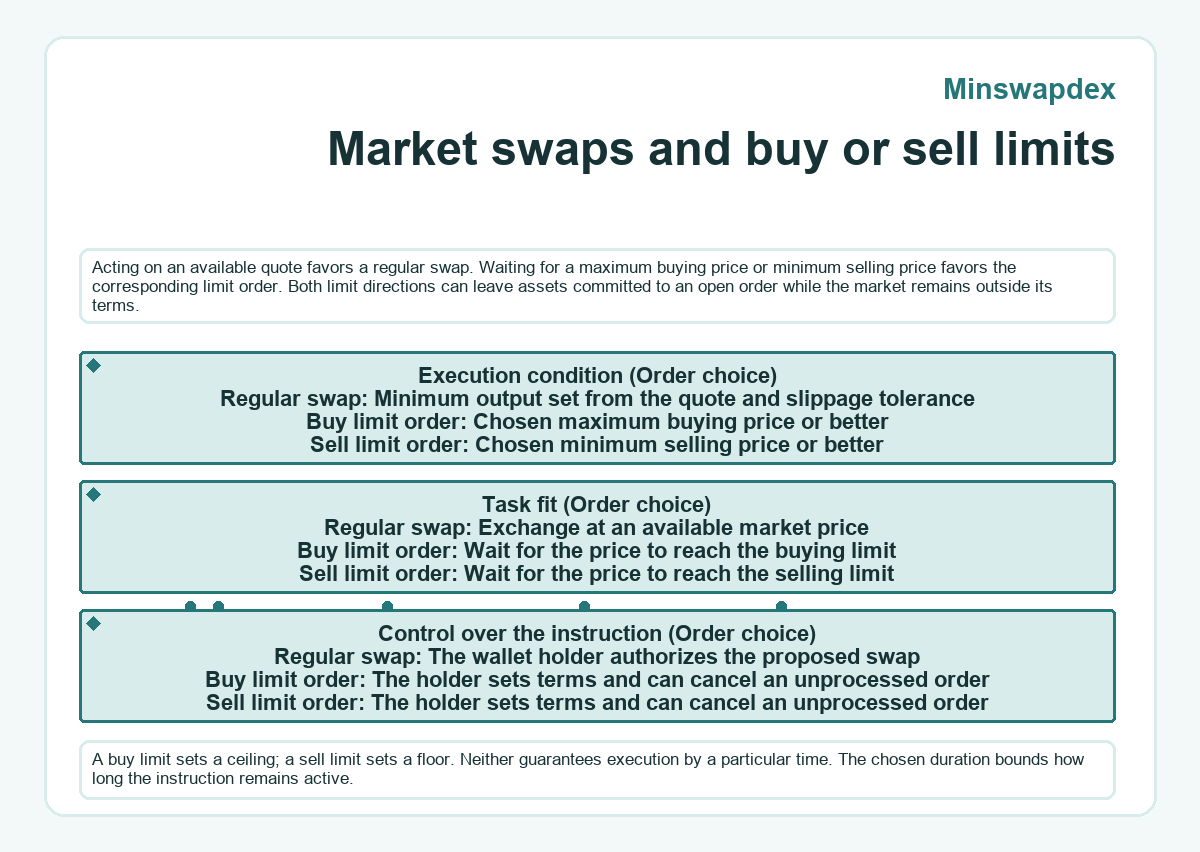
Acting on an available quote favors a regular swap. Waiting for a maximum buying price or minimum selling price favors the corresponding limit order. Both limit directions can leave assets committed to an open order while the market remains outside its terms.
Market swaps and buy or sell limits
- Execution condition (Order choice) Regular swap: Minimum output set from the quote and slippage tolerance Buy limit order: Chosen maximum buying price or better Sell limit order: Chosen minimum selling price or better
- Task fit (Order choice) Regular swap: Exchange at an available market price Buy limit order: Wait for the price to reach the buying limit Sell limit order: Wait for the price to reach the selling limit
- Control over the instruction (Order choice) Regular swap: The wallet holder authorizes the proposed swap Buy limit order: The holder sets terms and can cancel an unprocessed order Sell limit order: The holder sets terms and can cancel an unprocessed order
| Order choice | Execution condition | Task fit | Control over the instruction |
|---|---|---|---|
| Regular swap | Minimum output set from the quote and slippage tolerance | Exchange at an available market price | The wallet holder authorizes the proposed swap |
| Buy limit order | Chosen maximum buying price or better | Wait for the price to reach the buying limit | The holder sets terms and can cancel an unprocessed order |
| Sell limit order | Chosen minimum selling price or better | Wait for the price to reach the selling limit | The holder sets terms and can cancel an unprocessed order |
A buy limit sets a ceiling; a sell limit sets a floor. Neither guarantees execution by a particular time. The chosen duration bounds how long the instruction remains active.
Set the payment amount, limit price, and duration
A limit order needs a paying asset, an amount to commit, a price condition, and a duration. Selecting Limit in the trading interface changes the instruction from accepting an available market quote to waiting for specified terms. The payment amount determines how much of the selected asset the order uses.
The limit price expresses the acceptable exchange rate. Buying sets the maximum price per unit of the receiving asset. Selling sets the minimum price that the holder accepts.
Duration determines the period during which the order remains active. Expiry ends that waiting period if the trade conditions remain unmet, and the committed assets return under the order’s expiry terms. A selected duration describes the instruction’s lifetime, not an estimate of how quickly it will fill.
The limit-order interface supports setting a price relative to the market. That choice defines an order condition; it does not forecast a market move or its timing.
Reviewing these fields together prevents confusing the paying amount with the token amount expected from an eventual exchange. The price constraint governs the trade, while any applicable transaction charges remain a separate cost consideration. Place order precedes wallet confirmation; signing approves the instruction that those fields describe.
Signing and submission precede trade execution
The wallet signature authorizes an order transaction, and submission sends that transaction for processing on Cardano. Once the order reaches the chain, it can await the trading conditions specified by the holder. An on-chain order establishes a committed instruction. It does not, by itself, establish receipt of the asset that the holder wanted to buy.
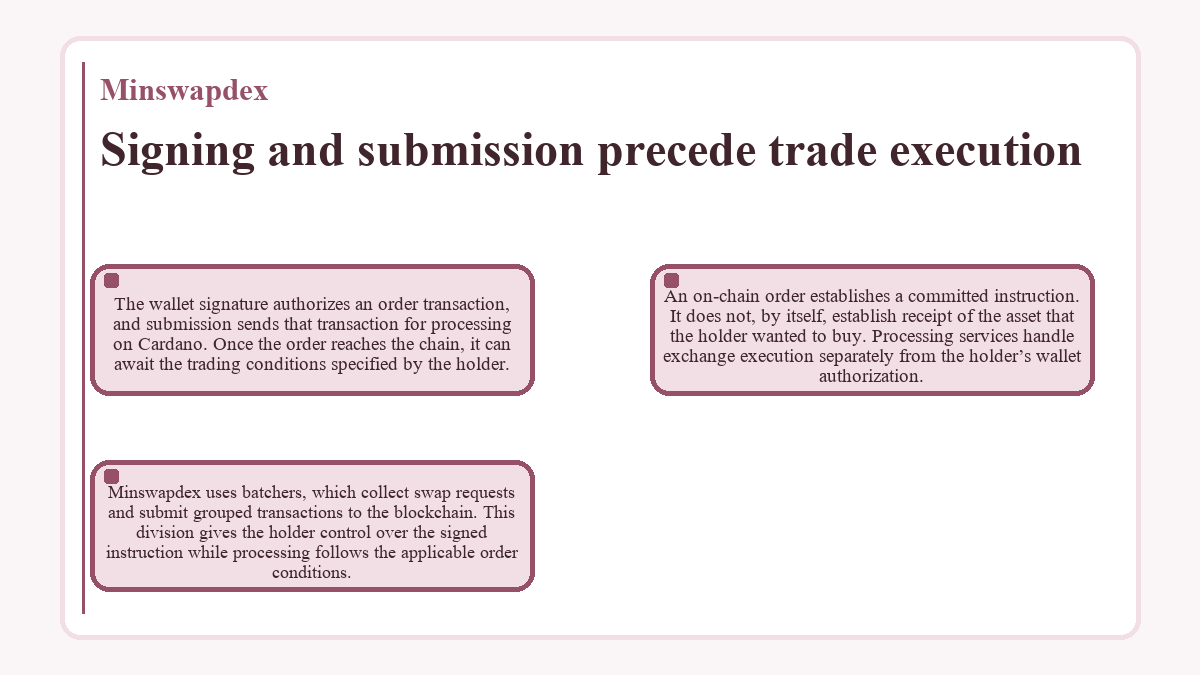
Processing services handle exchange execution separately from the holder’s wallet authorization. Minswapdex uses batchers, which collect swap requests and submit grouped transactions to the blockchain. This division gives the holder control over the signed instruction while processing follows the applicable order conditions.
Pending orders and wallet balances describe different states
Your orders displays active instructions that still await processing, making it the relevant view for an open limit order. The amount that the holder committed belongs to that order, while the expected receiving amount describes its intended exchange. Neither amount should be mistaken for newly received tokens solely because the order appears on-chain.
For a completed trade, the relevant outcome is the exchange of the paying asset for the receiving asset. Cancellation and expiry have a different outcome: they return the assets that the unfilled instruction committed. Pool statistics or portfolio performance can provide context, but they do not establish that an individual pending order has executed.
Cancel orders that have not been processed
Unprocessed limit orders can be cancelled through Your orders. Cancellation requires wallet authorization and returns the paying assets committed to the waiting instruction. Its scope ends at unprocessed orders; it does not reverse a completed token exchange.
Price impact and slippage describe different price changes
Price impact describes how the trade itself changes a pool’s price; slippage compares the expected price with the execution price. The first depends partly on trade size relative to available liquidity. A small pool can experience substantial impact even when the trade amount would look modest elsewhere. Pool liquidity therefore matters when interpreting a quote or deciding whether its price fits the intended exchange.
Slippage tolerance sets how far a swap’s output may fall below the quoted amount. Tightening that setting limits acceptable deviation, but it does not create liquidity or erase the price impact already present in a quote. A limit order addresses a different preference: execution at a chosen price or better. That preference can justify waiting, provided the holder can leave the paying assets committed while the order remains open.
Trading costs follow the selected function
Pool charges, processing charges where applicable, and the Cardano network fee affect different parts of an exchange. A quoted token amount describes the proposed exchange; a transaction charge pays for the relevant operation. A limit price should therefore remain distinct from the total wallet balance needed to authorize the trade.
LP token holders can vote to delegate authority over their pool’s trading fees. Separate product interfaces can also display their own processing charges or transaction-cost allowances. Those charges apply to the stated interface and operation. Read the charges attached to the selected operation before authorization, particularly when moving between ordinary token trading and a separate beta product.
Staking withdrawals follow the selected MIN contract
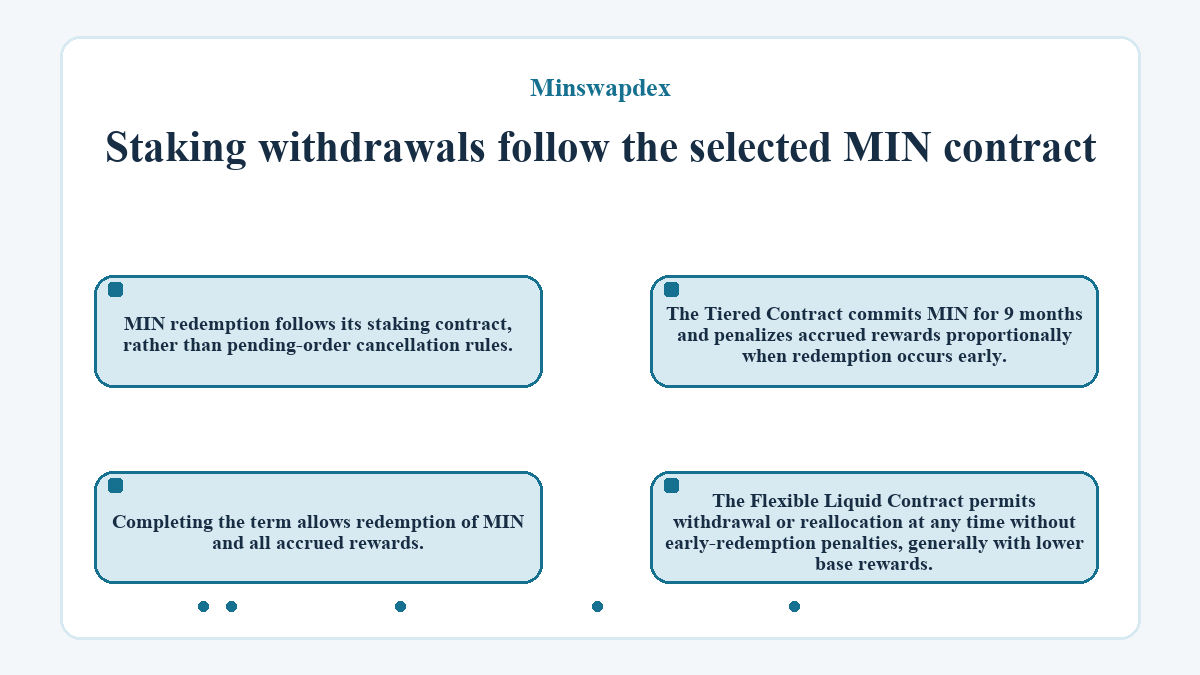
MIN redemption follows its staking contract, rather than pending-order cancellation rules. The Tiered Contract commits MIN for 9 months and penalizes accrued rewards proportionally when redemption occurs early. Completing the term allows redemption of MIN and all accrued rewards. The Flexible Liquid Contract permits withdrawal or reallocation at any time without early-redemption penalties, generally with lower base rewards.
Pool fee managers need delegated authority
LP token holders can delegate a pool’s fee-management authority through a proposal and vote. An LP token represents a liquidity-provider position. Connecting a trading wallet or holding MIN does not automatically confer the fee-manager role. An approved manager can adjust that pool’s fees, and an NFT controls the delegation.
The available proposal depends on the pool’s existing management state. Delegation appoints a manager when none exists. Revocation removes an existing manager’s authority, while transfer assigns that authority to a new manager. Under this proposal system, the proposer must hold LP tokens and provide a 100 ADA deposit. The deposit returns if the proposal passes; a failed proposal sends it to the ADA-MIN Pool v2.
Monitor each position in its relevant trading environment
Analytics provides pool liquidity, trading volume, fee generation, token statistics, and historical performance for interpreting activity. The portfolio view covers liquidity positions, earnings, and farming yields. Liquidity provision and yield farming concern pool positions, while a pending limit order concerns a particular exchange instruction.
Margin Beta presents borrowing and repayment controls, including a Nitro Wallet connection prompt. Borrow more ADA and Sell to Repay concern borrowed funds and repayment. Cancelling an ordinary spot order does not settle that separate borrowing position, which needs its own repayment action.
The separate Smart-Token DEX Beta concerns Cardano CIP113 tokens. When it reports no ADA-token pool for the selected token, that environment lacks the pool needed for the intended trade.
Still wondering about Minswapdex?
Can several pending orders be selected for cancellation together?
Your orders supports selecting multiple unprocessed orders for cancellation together. The holder can expand the relevant entries and choose the orders to cancel, then authorize the request through the wallet. Each selected order must still await processing. This grouped selection concerns open orders and does not provide a way to reverse trades that have already completed.
Where should a sending password be entered for an order signature?
Enter a requested sending password in the wallet’s own transaction-confirmation prompt. It authorizes the wallet to sign the transaction described there. A recovery phrase restores control of the wallet and serves a different purpose. Signing an exchange order does not require entering that recovery phrase into the exchange interface.
Does a limit order require another trader to accept it directly?
A pool-based limit trade executes against liquidity when its conditions allow processing. Minswapdex uses liquidity pools for these exchanges, so the order does not require a named buyer or seller to accept it directly. The chosen price condition still governs execution. Submission therefore establishes neither an immediate exchange nor a fixed completion time.
When do monthly fee-switch rewards reach MIN stakers?
ADA rewards from the Fee Switch accumulate during one month and are distributed in the following month. Their amount comes from the trading-fee revenue allocated to stakers. The monthly payout cycle is separate from the nine-month commitment of the Tiered Contract.
Who qualifies to vote on a pool fee-manager proposal?
LP token holders included in the proposal’s snapshot qualify to vote on that pool’s fee-manager proposal. Eligibility follows the pool’s LP holdings recorded by that snapshot, rather than simply holding MIN or connecting a wallet. The snapshot precedes the proposal’s start. Once a holder casts a vote, the fee-governance rules do not allow that vote to be undone.
Is a partner-token airdrop a fixed reward for every MIN staking position?
Partner-token airdrops are potential incentive rewards, so staking MIN does not establish a fixed airdrop entitlement. The staking rewards include ADA generated from trading-fee revenue, with monthly distributions. Partner projects can provide additional incentives under their own arrangements. Keep those possible extras separate from the redemption conditions attached to the selected MIN staking contract.
What does the CIP113 transaction-cost allowance cover?
The CIP113 trading interface separates its transaction-cost allowance from its batcher fee. It displays 2.8 ADA for the batcher and an additional 5 ADA to cover transaction costs. The interface specifies a refund of the 5 ADA if it is not needed. That allowance is separate from the token purchase amount, and these displayed charges apply to the CIP113 interface.