 Minswapdex
Minswapdex yield farming combines pool fee income with incentives for eligible Cardano liquidity positions
Minswapdex yield farming adds farm incentives to fee-earning Cardano liquidity positions when their liquidity-provider (LP) tokens qualify for the selected farm. Trading activity drives pool fee income, while reward allocations and the staked share govern incentives. Some farms distribute MIN, some distribute a project token, and some combine both. Those rewards accompany exposure to the pool’s paired assets. Their prices and changing composition can reduce the position’s value even while rewards accumulate. A useful return comparison accounts for fee income, received rewards, transaction costs, and underlying liquidity value without counting fees already reflected in that liquidity value twice. Direct MIN staking uses a different input and reward arrangement.
· last updated
The short version: Staking part of an eligible LP balance changes farm participation while the full pool claim retains its share of trading fees.
Pool eligibility and recorded LP stakes
Participation requires liquidity-provider (LP) tokens for a pool with an applicable farm; an accepted deposit records the chosen stake and begins incentive accrual. A pool share that remains outside a MIN farm does not participate in that farm’s MIN allocation. Providing liquidity creates the pool claim, while staking eligible LP tokens establishes the farming position. These operations have different purposes even when an interface brings their controls together.
Eligible liquidity belongs to a particular pool
The farm accepts LP tokens associated with its particular pool. Holding one of the pool’s assets alone does not establish an LP stake. The available farm program also identifies its incentive assets, so a project-token farm should not be assumed to offer MIN.
Recorded stake and accrued rewards
A wallet signature authorizes the proposed farm transaction, and submission sends it for processing. The farm’s recorded staked balance shows that the deposit has taken effect. A submitted transaction alone does not establish that recorded position. The stake remains a claim on the underlying liquidity through its LP tokens.
An accrued reward balance reports earnings available to harvest. A completed harvest delivers those reward tokens to the wallet.
Trading fees and incentives draw on different balances
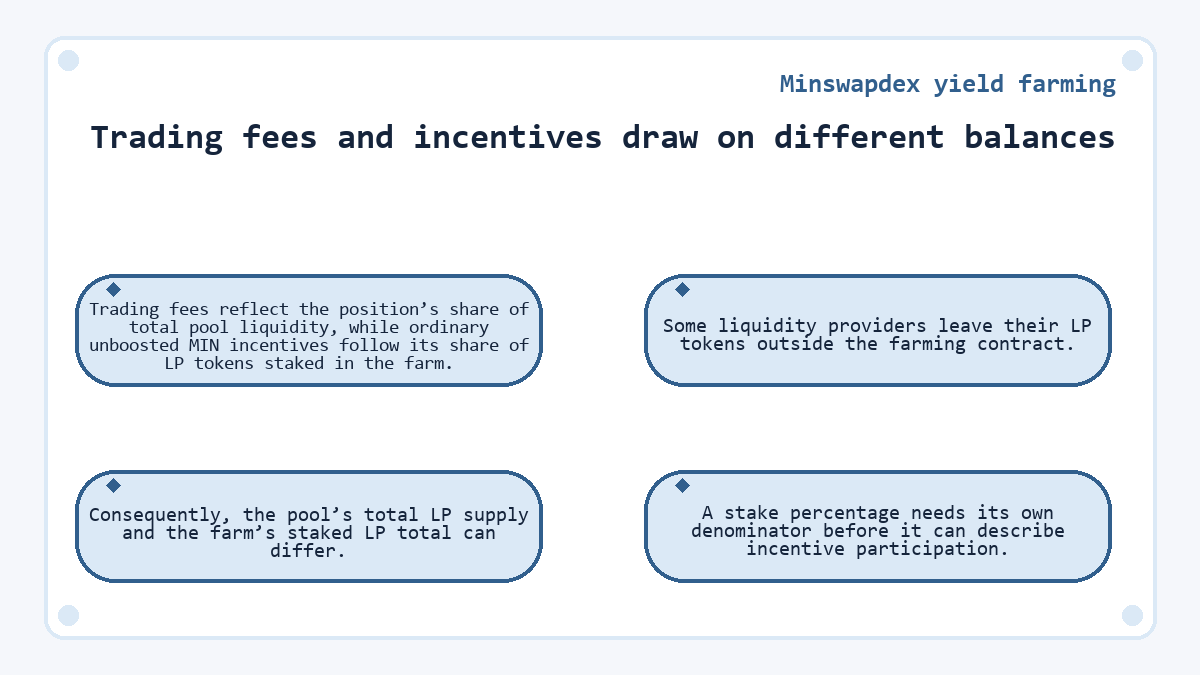
Trading fees reflect the position’s share of total pool liquidity, while ordinary unboosted MIN incentives follow its share of LP tokens staked in the farm. Some liquidity providers leave their LP tokens outside the farming contract. Consequently, the pool’s total LP supply and the farm’s staked LP total can differ. A stake percentage needs its own denominator before it can describe incentive participation.
Trading activity supplies fee income
More trading generates more fees when the pool fee rate and other conditions remain comparable. The fee that the pool charges and the portion that accrues to liquidity providers determine the relevant income. Pool fee governance allows LP holders to delegate fee management. A manager’s permitted fee adjustment changes the income that a given trading volume generates.
Greater liquidity spreads fee income across a larger pool value. Trading volume relative to liquidity helps explain the resulting fee yield.
MIN and project-token programs
MIN-only farms offer MIN incentives. Own Token Farms offer the participating project’s token, while combined farms offer both streams. Project-funded rewards follow the program’s allocation and duration. A combined farm adds another reward asset with its own market value. It does not change the paired assets represented by the LP tokens.
Why can a farm’s APR change after entry?
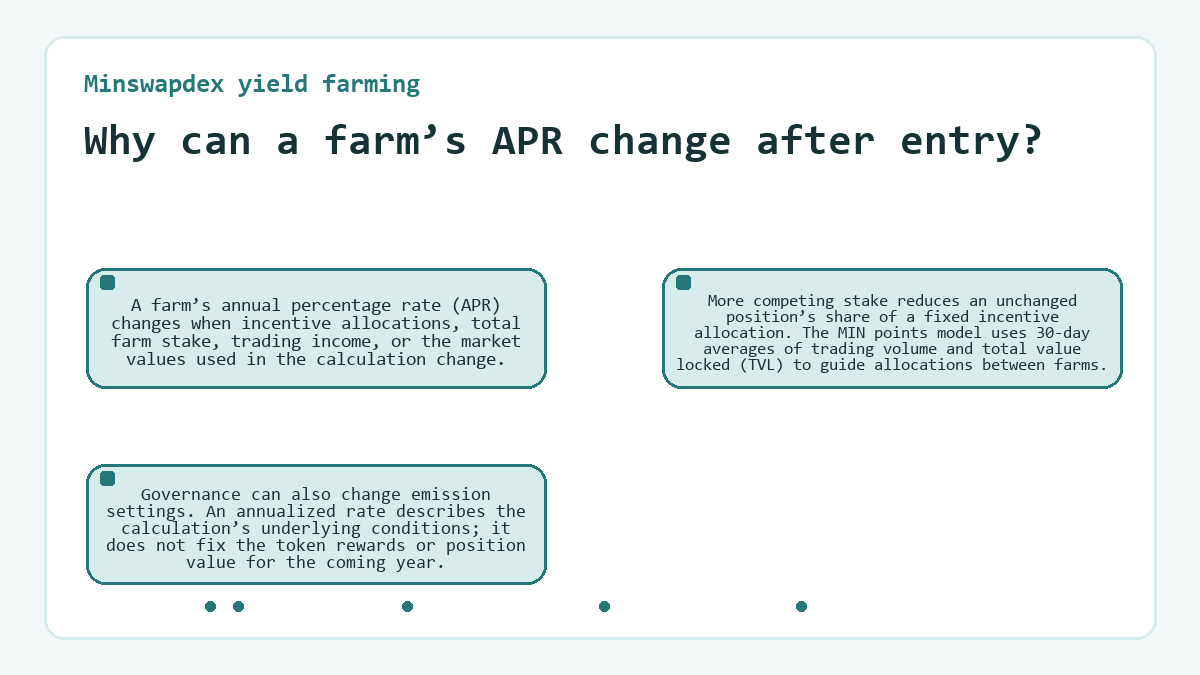
A farm’s annual percentage rate (APR) changes when incentive allocations, total farm stake, trading income, or the market values used in the calculation change. More competing stake reduces an unchanged position’s share of a fixed incentive allocation. The MIN points model uses 30-day averages of trading volume and total value locked (TVL) to guide allocations between farms. Governance can also change emission settings. An annualized rate describes the calculation’s underlying conditions; it does not fix the token rewards or position value for the coming year.
How can a farm earn rewards while losing value?
A farm can accrue incentives while the market value of its underlying liquidity falls or underperforms holding the original deposited assets.
Relative token prices change the asset mix
Trading against an automated market maker changes the quantities of tokens in the pool as their relative prices move. The LP claim therefore covers a changing asset mix. Impermanent loss describes underperformance caused by changing relative token prices compared with holding the original deposited assets. Fees and incentives can offset that difference, but their value may be insufficient. A position can also lose absolute value when its underlying assets decline, independently of the comparison with holding them.
A reward balance still has a market value
More reward tokens do not necessarily mean more reward value. A falling MIN or project-token price can reduce what the accumulated balance is worth.
Pool income and incentive balances need a common valuation unit and a consistent time interval for a meaningful return comparison. Include rewards already received, avoid counting them again in an accrued balance, and account for capital added or removed during that interval. The number of reward tokens alone leaves out the value of the liquidity that produced them.
LP ownership does not remove contract risk
The pool contract holds the underlying assets, while the farming contract holds the staked LP tokens. Only the position owner can authorize withdrawal of those staked tokens. That control does not prevent a vulnerability in either contract from affecting the position. Recovering the underlying assets depends on both the LP claim and the contracts that handle it.
A partial stake and the cost of harvesting
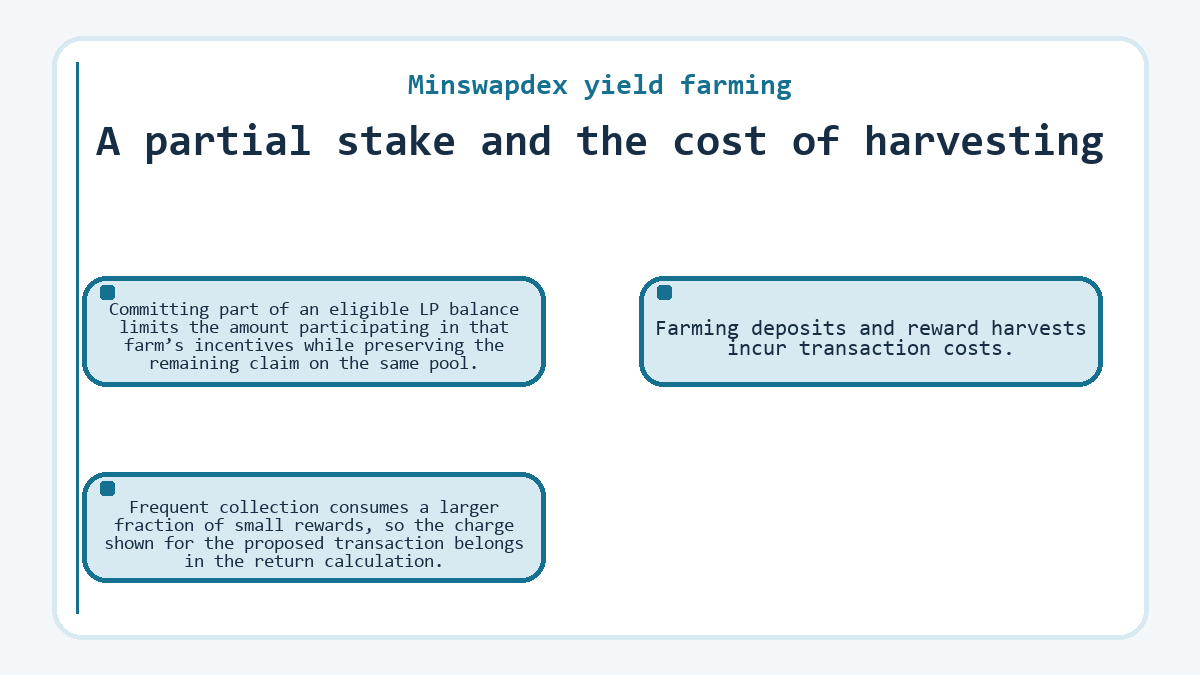
Committing part of an eligible LP balance limits the amount participating in that farm’s incentives while preserving the remaining claim on the same pool. Farming deposits and reward harvests incur transaction costs. Frequent collection consumes a larger fraction of small rewards, so the charge shown for the proposed transaction belongs in the return calculation.
A partial deposit into an unboosted MIN farm
Consider a hypothetical deposit into an unboosted MIN farm. The wallet holds 12,347 eligible LP tokens; the chosen stake is 7,117 LP tokens, and total farm stake after acceptance is 58,917 LP tokens. Before signing and submitting, the holder can revise the amount or abandon the proposed deposit. Submission still precedes the recorded position. Once the farm records the chosen stake, 5,230 LP tokens remain outside that farm. They continue to represent liquidity in the same pool.
The farm share is 7,117 divided by 58,917, or approximately 12.08%. That ratio applies to the farm’s MIN incentive allocation while these hypothetical balances remain unchanged. All 12,347 LP tokens still represent the holder’s claim on the original pool. Staking a portion therefore does not reduce that claim’s participation in pool fee income. If additional LP tokens enter the farm while this stake stays unchanged, its percentage of a fixed MIN allocation falls.
The reward view records MIN accrued by the position. That amount remains separate from MIN delivered to the wallet by harvesting.
Harvesting leaves the LP stake in place. Unstaking releases LP tokens from the farm, while removing liquidity redeems the pool claim. Zap Out additionally converts withdrawn liquidity into a selected single asset. That conversion introduces a trading component to the exit, so received farm rewards and assets obtained from liquidity removal need separate accounting.
The approved LP reward buyback separates payouts from burns
The LP staking-reward vote that closed on 22 December 2025 approved Option C, Full conversion with Burn. Its design converts all weekly ADA LP staking rewards into purchased MIN, distributes 50% of that purchased MIN to LP stakers, and burns 50%. These percentages concern purchased MIN, separate from pool trading fees and farm emissions. The approved design specifies the treatment; an individual payout record establishes the MIN actually received. The burned portion never becomes a farmer’s received reward balance.
Minswapdex yield farming: questions and answers
Are standard MIN farm rewards calculated once per Cardano epoch?
Standard MIN farming uses reward accounting at one-second resolution, so collecting accrued MIN does not require waiting for a full Cardano epoch. This describes the farm incentive stream. A separate reward component can have its own distribution schedule, and the elapsed accrual time does not establish transaction completion or a wallet receipt.
Can additional LP tokens enter an existing MIN farm position?
Additional eligible LP tokens can enter an existing MIN farming position. Adding them calculates the MIN accrued since the previous deposit or withdrawal and creates a pending harvest for delivery to the wallet. Subsequent farming uses the increased LP stake. The extra tokens change future participation; they do not retroactively enlarge the stake that earned earlier rewards.
What happens to accumulated MIN when only part of the farm stake is withdrawn?
A partial withdrawal calculates the MIN accrued since the previous deposit or withdrawal and creates a pending harvest for delivery of those rewards to the wallet. The remaining LP tokens continue farming with their reduced staked amount. This changes the incentive position without redeeming every pool share, so the LP tokens withdrawn from the farm still represent liquidity until that claim is redeemed.
Does collecting MIN rewards automatically increase the farm stake?
Collecting MIN rewards delivers MIN to the wallet without increasing the staked LP balance. A larger farm stake requires additional eligible LP tokens. Harvested MIN can fund a liquidity addition, whose eligible LP tokens can increase the stake. Costs associated with those actions reduce the value available for reinvestment.
Is a raw LP token count suitable for comparing different pools?
Raw LP token counts do not provide a meaningful return comparison across different pools. Each pool has its own assets, LP supply, and value per pool share. Compare the value represented by the position and the value of its rewards using the same valuation unit and time interval; equal token counts need not represent equal capital.
Where are changes in a farm’s historical yield visible?
Farming analytics include historical yields alongside annualized rates and reward metrics. Pool analytics also show trading volume, liquidity, and fees earned. These views help distinguish changing trading income from changing incentives. Historical rates describe earlier conditions, while a portfolio view concerns the holder’s positions and earnings.
Who pays the setup fee for an Own Token Farm?
The project establishing an Own Token Farm pays the one-time 500 ADA charge under that program’s setup terms. This is a project setup cost, separate from transaction costs that individual farmers incur. The project also chooses the token allocation and program duration. Its setup charge and token-funded incentive budget are distinct amounts.